Last Updated Sept 12 2026
Walking around Echo Park Lake, spending time in Elysian Park, or moving through the neighborhood around Sunset Boulevard and Echo Park Avenue can make joint pain or an orthopedic injury especially noticeable. Urgent Orthopaedic Care is located at 1711 W Temple St, Suite 4607 in Los Angeles, near Echo Park. Board-certified orthopedic surgeon Vlad Gendelman, MD, QME evaluates adult orthopedic concerns including fractures, arthritis, rotator cuff tears, sports injuries, and joint problems. The practice offers limited on-site diagnostic imaging, including X-rays, and treatment options ranging from conservative care to arthroscopy, joint replacement, fracture repair, and other surgery when clinically appropriate. Some injuries may require additional imaging, hospital care, or another specialist depending on severity and diagnosis.
Book Your Echo Park Appointment | Call (323) 933-3434
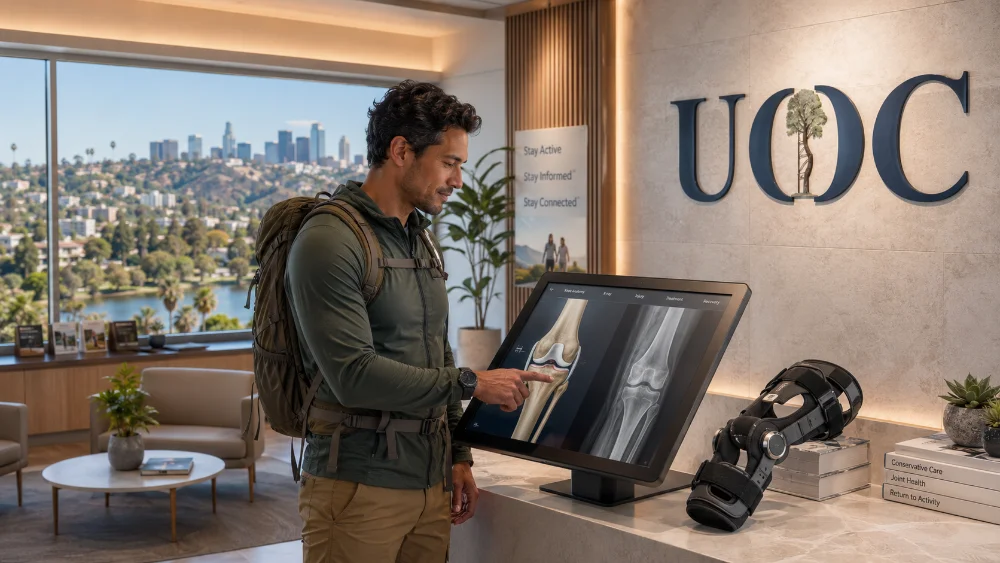
Urgent Orthopaedic Care is structured as a general orthopedic practice rather than a single-joint office. Dr. Gendelman evaluates adult musculoskeletal problems involving the shoulders, hands, hips, knees, fractures, and sports injuries and considers conservative or surgical treatment according to the diagnosis. Limited on-site diagnostic imaging, including X-rays, may help evaluate selected injuries during the visit. Some conditions still require advanced imaging, emergency care, hospitalization, or referral to another specialist, so the appropriate setting depends on the injury and examination.
People seek orthopedic care for many reasons, including sudden sprains or fractures, persistent shoulder or joint pain, arthritis that is limiting activity, sports injuries, and work-related or personal-injury cases. The visit begins with a history and focused orthopedic examination, followed by imaging when appropriate. Dr. Gendelman then explains the diagnosis or possible causes, available treatment options, and whether conservative care, additional testing, or surgery should be considered.
Urgent Orthopaedic Care does not have an office inside Echo Park. The Los Angeles office is at 1711 W Temple St, Suite 4607, near the 90026 area. Patients may be starting near Echo Park Lake, Elysian Park, or the Sunset Boulevard and Echo Park Avenue area, but driving time varies with traffic, road conditions, and starting point. Check current navigation before travelling rather than relying on a fixed drive-time estimate.
The Temple Street location provides a nearby Los Angeles option for people seeking orthopedic evaluation from Echo Park and surrounding neighborhoods. Traffic and parking conditions can change throughout the day, so patients should check current directions and contact the office if they need parking, building-access, or accessibility information before their visit.
For non-life-threatening orthopedic concerns, patients can call the office to ask about the next available appointment and whether the injury is appropriate for office evaluation. Patients who were first seen at an urgent care center or emergency department can bring prior X-rays, reports, and records when available. Open fractures, severe bleeding, major trauma, or signs of impaired circulation or nerve function require emergency evaluation rather than waiting for an office appointment.
When choosing orthopedic care, patients may consider the surgeon’s credentials, scope of practice, available diagnostic services, conservative treatment options, and experience with surgical care. The points below summarize current features of Urgent Orthopaedic Care’s Los Angeles practice.
Orthopedic treatment goals depend on the diagnosis, severity of injury, baseline function, and individual patient. Care may focus on reducing pain, protecting an injured structure, improving mobility, supporting fracture healing, or helping a patient work toward returning to appropriate daily or recreational activity.
Knee or hip arthritis can make walking and other daily activities uncomfortable, including time spent around Echo Park Lake. Evaluation may include examination and imaging, with nonsurgical options considered first when appropriate. If symptoms and joint damage remain severe despite conservative care, joint replacement or another procedure may be discussed. Treatment aims to reduce symptoms and improve function, but expected benefit and recovery vary by patient and procedure.
Sprains, fractures, and other injuries can interrupt hiking or everyday activity around Elysian Park. The office evaluates selected orthopedic injuries with examination and limited on-site imaging, including X-rays when appropriate. Treatment may include bracing, activity modification, rehabilitation, or surgical repair depending on the injury. More severe trauma or injuries requiring emergency care should be evaluated in an emergency department.
Limited on-site diagnostic imaging, including X-rays, may allow Dr. Gendelman to evaluate some injuries and discuss next steps during the same visit. A single office visit cannot establish every diagnosis, and some problems require MRI, CT, repeat imaging, laboratory testing, or hospital evaluation. The diagnostic plan depends on the injury, examination findings, and available imaging.
Echo Park’s steep streets, including Baxter Street, can make hip, knee, or ankle symptoms more noticeable during daily activity. Care is based on the diagnosis and may include activity changes, bracing, injections, rehabilitation, MLS laser therapy as an adjunct when appropriate, or surgery when clinically indicated. The treatment plan should reflect the cause and severity of the problem rather than promise a particular level or timing of recovery.
The practice groups its care into four working areas so patients can see how a visit fits together. Each is delivered at the Temple Street office.
Arthroscopic surgery uses small incisions and a camera to diagnose and repair problems inside a joint, which can mean less disruption to surrounding tissue than open surgery. Dr. Gendelman uses arthroscopic techniques for issues such as rotator cuff tears, meniscus damage, and other joint injuries where a minimally invasive approach fits. Every case begins with an exam and imaging to confirm that arthroscopy is the right tool before anything is scheduled.
Joint replacement may be considered when advanced joint damage causes significant pain and loss of function that has not responded adequately to nonsurgical care. Hip fracture treatment is different and can be time sensitive, particularly in older adults, with treatment determined by the fracture pattern, overall health, and hospital assessment. Dr. Gendelman reviews the expected benefits, risks, alternatives, and recovery plan for the specific procedure before surgery.
Urgent Orthopaedic Care evaluates selected fractures, sprains, and sports injuries that are appropriate for outpatient orthopedic care. Limited on-site X-rays may help evaluate some injuries, while casting, bracing, rehabilitation, or surgical repair may be recommended based on the diagnosis. Open fractures, severe bleeding, major trauma, or a limb that becomes numb, pale, cold, or otherwise shows signs of compromised circulation or nerve function require emergency care rather than waiting for an office visit.
Not every orthopedic problem requires surgery. Depending on the diagnosis, conservative care may include activity modification, bracing, injections, rehabilitation, or MLS laser therapy as an adjunct. The practice offers MLS laser therapy for selected musculoskeletal pain conditions, but expected benefit varies by diagnosis and patient. Laser therapy should not be presented as a guaranteed way to accelerate healing or eliminate inflammation, and it does not replace fracture management, rehabilitation, or surgery when those are clinically indicated.
Care at the Temple Street office is led by a board-certified orthopedic surgeon and supported by an experienced rehabilitation and injury-evaluation team.
Dr. Vlad Gendelman founded Urgent Orthopaedic Care and is board-certified by the American Board of Orthopaedic Surgery, a Fellow of the American Academy of Orthopaedic Surgeons, with more than 18 years in orthopaedics. He earned a Bachelor of Science in Biology from the University of Southern California, his medical degree from the University of California, Irvine, and completed a five-year residency in orthopaedic surgery at SUNY Downstate. What defines his practice is breadth: rather than limiting himself to one joint, he treats the full range of adult orthopedic problems, from shoulders and hands to hips, knees, fractures, and sports injuries. He holds membership in the Los Angeles County Medical Association, the California Medical Association, and the California Orthopaedic Association, has contributed research on arthritis and related topics, and as a Qualified Medical Evaluator also manages work-related and medical-legal cases.
Dr. Rene Nevarez is a board-certified chiropractic physician, board-certified orthopedic technologist, and board-certified orthopedic physician extender who has worked alongside Dr. Gendelman since 2013. She graduated from Southern California University of Health Sciences in 2007 and serves as his first assistant in surgery while seeing patients at the Los Angeles office. As a Qualified Medical Evaluator for California, she has built an extensive background managing complex work-injury cases, and she is a Certified Kinesio Taping Practitioner who also holds a certification in biofeedback for chronic pain.
Dr. Yvette A. Aghakhanians is a board-certified chiropractic physician with more than 22 years of clinical experience, focused on sports-related, personal, and work-related injuries. She graduated from Cleveland Chiropractic College, Los Angeles in 2002, has been a Qualified Medical Evaluator since 2023, and is an active member of the American Chiropractic Association. Fluent in Armenian with conversational Farsi and Spanish, she is known for making patients feel heard, and as a longtime CrossFit athlete and half-marathoner she brings a firsthand understanding of staying active.
Dr. Patrick Issagholiantce is a chiropractic physician with 25 years of experience in multi-disciplinary practice evaluating and treating industrially related injuries, following his graduation from Cleveland Chiropractic College. He is known for being diligent and compassionate with patient care, exploring the full set of approaches and alternatives to help an injured worker recover. Outside the clinic he enjoys the outdoors, gardening, reading, and time with his family.
Urgent Orthopaedic Care does not have a separate office inside Echo Park. The Los Angeles office is at 1711 W Temple St, Suite 4607, near the 90026 area. Patients travelling from Echo Park Lake, Elysian Park, or other parts of the neighborhood should check current directions because travel time varies with traffic and starting point.
Yes. Limited diagnostic imaging, including X-rays, is available at the Temple Street office. Depending on the injury, this may help Dr. Gendelman evaluate the problem and discuss next steps during the visit. Some conditions require additional imaging, such as MRI or CT, or evaluation at another facility.
Yes. The practice treats workers’ compensation and personal injury cases and completes QME, AME, and IME evaluations. Mention that your case is work-related or injury-related when you schedule so the right paperwork is ready.
Urgent Orthopaedic Care provides orthopedic care from its Temple Street office near Echo Park. Areas and corridors relevant to the local service area include:
Daily activity around Echo Park can make orthopedic symptoms more noticeable, whether that means walking around Echo Park Lake, spending time in Elysian Park, or moving through the neighborhood around Sunset Boulevard and Echo Park Avenue. Joint pain, sprains, fractures, and other musculoskeletal problems can affect walking, recreation, work, and other routines. Urgent Orthopaedic Care’s Temple Street office provides weekday orthopedic evaluation near Echo Park, with appointment availability and the appropriate care setting confirmed when scheduling.
These reviews describe individual patient experiences. Diagnosis, treatment recommendations, complications, recovery, and results vary from person to person.
“From the beginning to the end the office staff was great. The surgery was a success and I couldn’t be any happier with the recovery and the care the office and doctors gave me. Top notch service and surgery.”
“Dr. Vlad G., Dr. Navarez, and all the other specialists, including the office staff at both LA city and Tuluca Lake, words cannot describe how grateful I am for all the attention and care I received during these two years of treatment. More importantly, due to their expertise, I was able to return to doing what I love professionally and, hopefully, be able to operate for the coming years and retire on my terms and not due to injuries.”
“Very kind, professional, and thoughtful staff. The recommendations I was given to assist me with my disability were beneficial. The knowledge they shared with me was precious. I thank the doctor and his support team for all they have done for me as a patient. Thank you.”
Call (323) 933-3434 or request an appointment online to connect with the Urgent Orthopaedic Care team. The front desk can review current appointment availability, explain what prior imaging or medical records to bring, and help prepare workers’ compensation or personal injury paperwork when applicable. If an injury may require emergency care, seek emergency evaluation rather than waiting for an office appointment.
Call (323) 933-3434 | Book Your Echo Park Appointment
Urgent Orthopaedic Care 1711 W Temple St Ste 4607, Los Angeles, CA 90026
Pain after arthroscopic surgery varies by the joint and the procedure performed. Small incisions do not mean the procedure is pain-free. Soreness, swelling, and temporary activity limits are common, and arthroscopy also carries risks such as infection, blood clots, bleeding, and injury to nerves or blood vessels. Your surgeon will explain the expected pain-control and recovery plan for your specific procedure.
The surgeon makes a few small incisions and inserts a thin camera called an arthroscope to view the inside of the joint on a screen. Guided by that view, fine instruments are used to diagnose and repair the problem, whether that is a torn cartilage, a damaged ligament, or an inflamed structure. It is done as a same-day procedure in most cases.
Many patients can put some weight on the knee soon after arthroscopic surgery, often with crutches for support at first, but this depends on exactly what was repaired. Your surgeon gives you specific weight-bearing instructions before you leave. Following them closely helps protect the repair and supports a smoother recovery.
Yes, joint replacement is a significant operation in which a damaged joint surface is replaced with an implant, and it is typically considered only after conservative options have been exhausted. That said, it is a well-established procedure, and the recovery plan is mapped out clearly in advance. Outcomes and timelines vary from patient to patient.
The knee and the hip are by far the two most commonly replaced joints, usually because of advanced arthritis or a serious injury that has worn the joint down. Both are routine, well-studied procedures. A full evaluation determines whether replacement is the right step or whether other treatments should come first.
There is no single joint replacement that is hardest for every patient. Recovery differs between knee, hip, and other joint replacements and depends on the procedure, age, general health, pain control, muscle strength, rehabilitation, and complications. Your surgeon can explain the expected milestones for the specific operation being considered rather than comparing recovery based on the joint alone.
There is no single operating time for hip fracture surgery because fixation and replacement procedures differ. Hip fractures, particularly in older adults, usually require prompt hospital assessment, with surgical timing based on the fracture pattern, overall health, medical stability, and type of operation required. The orthopedic team will explain the expected procedure and timing after the fracture has been evaluated.
Activity and weight-bearing restrictions after a hip fracture depend on the fracture, operation, fixation, and your surgeon’s instructions. Do not assume that another patient’s precautions apply to you. Use your prescribed walker, crutches, or other support as directed, follow the physical-therapy plan, and do not place more weight on the injured side than your surgical team has allowed.
Many patients begin walking with a walker or crutches within a day or two of hip surgery and progress over the following weeks, with a return to more normal walking often taking several weeks to a few months. The timeline depends on the procedure, your health, and how rehabilitation goes. Consistent physical therapy is what moves it along.
There is no single hip fracture that is most serious in every patient. Femoral neck, intertrochanteric, and other proximal femur fractures can each be serious depending on displacement, blood supply, bone quality, age, other medical conditions, and associated injuries. Prompt hospital evaluation helps determine whether fixation, joint replacement, or another treatment is appropriate.
For a stable, non-life-threatening sprain, sports injury, or other orthopedic concern, you can call the office to ask whether outpatient evaluation is appropriate and what appointment times are available. Go to an emergency department or call 911 for major trauma, an open fracture with bone or a wound over the break, severe bleeding, loss of consciousness or serious head injury, or a limb that becomes numb, pale, cold, weak, or otherwise shows signs of impaired circulation or nerve function. If you are unsure whether an injury is an emergency, seek urgent medical assessment rather than delaying care.
Referral and prior-authorization requirements depend on your insurance plan and the service being scheduled. Some plans allow direct specialist visits, while others require a referral from a primary care clinician or prior authorization before certain services. Check your individual benefits and confirm any requirements with the office before your appointment.
MLS laser therapy is a noninvasive light-based treatment that the practice may use as an adjunct for selected musculoskeletal pain conditions. The appropriate use and expected benefit depend on the diagnosis, the specific device, and the individual patient. It should not be considered a substitute for fracture treatment, rehabilitation, medication when medically necessary, or surgery when those treatments are indicated. Ask the practice which MLS device is being used and what FDA-cleared indication applies to your treatment.
Yes. Orthopedic evaluation can help determine the type and severity of knee or hip arthritis and how much it is affecting function. Depending on the diagnosis, treatment may include activity modification, exercise or rehabilitation, medication when appropriate, injections, assistive devices, or other conservative measures. Joint replacement may be considered when advanced arthritis causes substantial symptoms that have not responded adequately to nonsurgical care. Any adjunctive treatment, including MLS laser therapy, should be considered according to the individual diagnosis and available evidence.
If you have a sports injury after activity in or around Elysian Park, call the office to ask about the next available appointment and whether outpatient orthopedic evaluation is appropriate. Limited on-site imaging, including X-rays, may help evaluate selected injuries, but some problems require additional imaging or another level of care. Because appointment availability changes, confirm the current schedule directly with the office.
If you want an orthopedic surgeon who will hear out how the injury happened and what you need to get back to, lay out the conservative and surgical choices in language that actually makes sense, and treat both the pain in front of you and the activity you are trying to return to, Dr. Gendelman and the Urgent Orthopaedic Care team are ready to help. Reach out by phone or online whenever a joint or bone problem needs attention, and the team will work you in from just up the road in Echo Park.
Book Your Visit With Dr. Gendelman Today
Book Your Echo Park Appointment | Call (323) 933-3434
Urgent Orthopaedic Care 1711 W Temple St Ste 4607, Los Angeles, CA 90026
https://www.urgentorthopaediccare.com/
Hours: